By Rebecca Carey.
The crew, scientists and the engineers are all on schedules so that the boat and our scientific operations can continue 24/7. The scientists and the vehicle engineers are on the same watches: 8-12, 12-4, 4-12 am and pm. That means that a group of people are on ‘watch’ for 4 hours and then they have 8 hours off.
While the Co-Chief Scientists have had a lot to do preparing for our arrival at the volcano, the other scientific participants have not had many jobs– so they have been finishing up assignments and continuing to work on their research projects, and very importantly get a number of blog posts about our voyage thus far on our website.
The cabins are twin share and the science cabins are on the 3rd deck above the main deck, and 2 decks below the main deck at, or below, the ocean surface. I am on the 3rd floor above the main deck and up at this elevation there is significant side-to-side swaying. I think the location of my cabin is better than 2 decks below, because those cabins are close to the thrusters at the front of the boat, which are very noisy, and the waves hitting the side of the boat are also noisy.
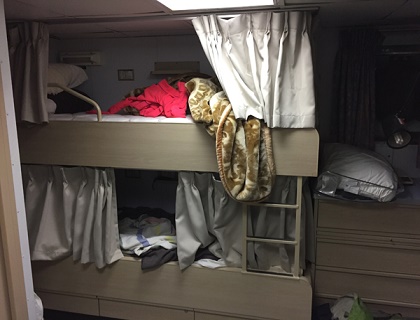
I am sharing my cabin with Meghan Jones, a PhD student at Woods Hole Oceanographic Institution. Meghan and I are on different schedules on the boat, so generally we get time to ourselves in the cabin but must be careful not to wake one another if we need to retrieve something from our cabin. For that reason I have moved a lot of my equipment and supplies to the working computer lab. The accommodation is fairly simple, bunk beds, a wardrobe and a shared bathroom with the next cabin.
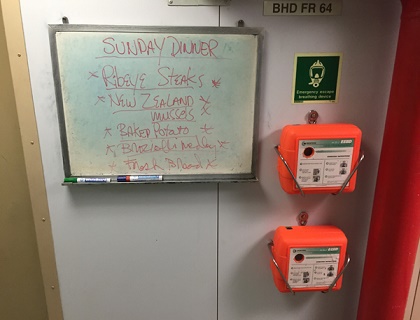
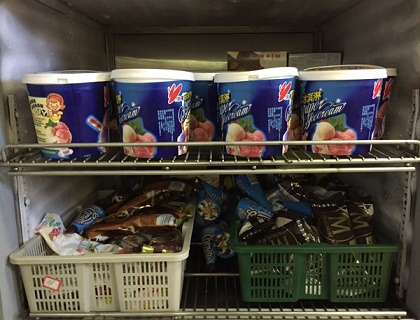
During the day we are allowed everywhere on board. The exceptions are when the vehicles are being deployed or retrieved from the water. There is a lot of machinery in action at that time, and can be dangerous. During the night however we are not allowed outside – the risk of going overboard without anyone noticing is too high. The food on board is absolutely delicious. Our Chefs are Mark and Marc from San Diego. Breakfast is between 7:30 and 8:15 am; Lunch between 11:30 and 12:15pm; Dinner between 5:30 and 6:15pm. If we’re late for breakfast, lunch or dinner or are on watch, we can always go to the refrigerator where the leftovers are stored. Desert is always on offer, and the icecream fridge is fully stocked…. With delicious icecreams like Cornetto and Magnum! It’s hard not to have icecream for breakfast lunch and dinner!
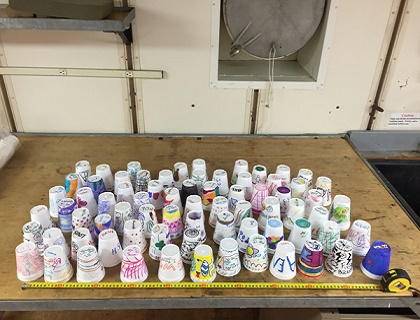
Since we left port, I have eaten pretty plain food like toast, rice, potatoes etc. because there is always 1-2 days at the start of a cruise where I feel a little bit seasick… perhaps in the next few days I’ll start to feel better and take advantage of all the delicious food on the menu! Our Bookend Trust cups have been prepared for a trip down to the seafloor tomorrow. Here is a picture of what they looked like before (tape measure is extended to 1m for scale). When they come back up I’ll take another picture to show the shrinking phenomena. Stay tuned! The cups go down to the seafloor on a piece of equipment called the ‘elevator’ this isn’t really an elevator but is a buoyant structure that initially is weighed down in the water by weights. On the elevator we have a range of different sized boxes so that the ROV can drop samples of pumice into them. We drop the elevator over the side of the boat with cranes. It sinks to the seafloor and is ready for samples delivered by the ROV. When it is full we trigger a mechanism to release the weights and because it is buoyant it rises to the seasurface where we collect it with the crane, put it on the boat and then look at our samples! On the next page is a time lapse sequence of images of us installing the boxes on the elevator. I’ve also attached a sequence of images that shows us putting the elevator in the ocean. I’ll keep you updated with life on board the ship and other adventures when we get the vehicles in the water!